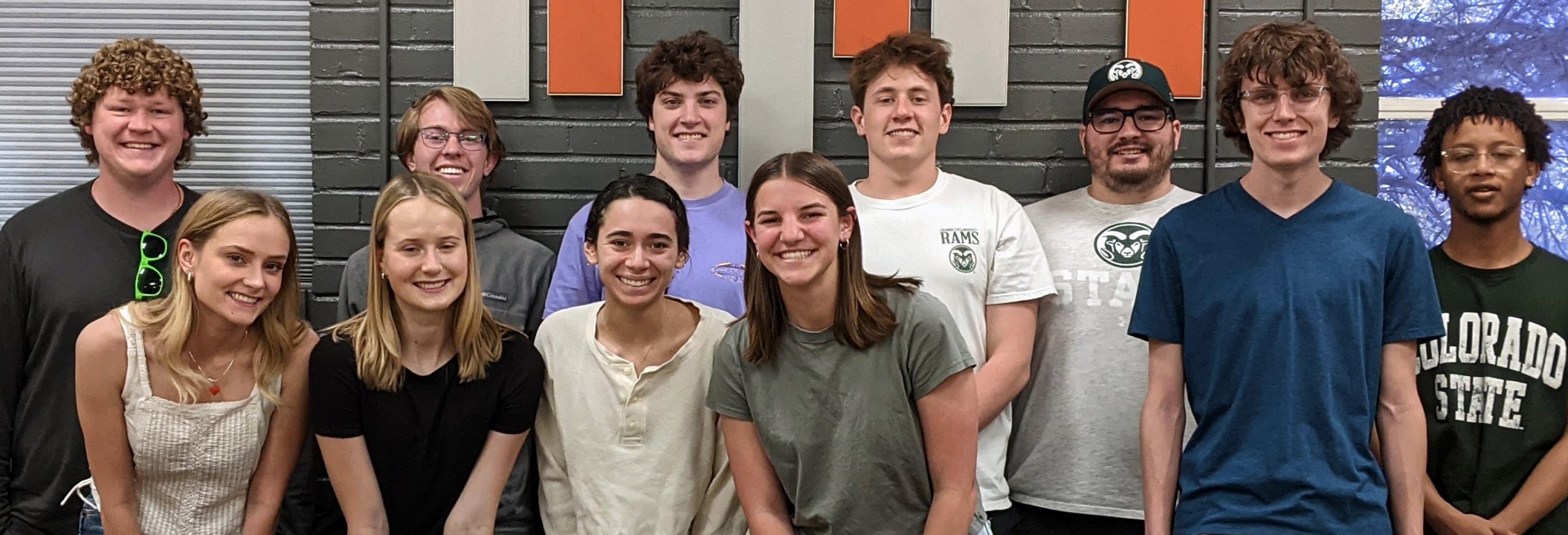
Since Summer 2022, the Statistics department and the College of Natural Sciences have offered paid research opportunities for Statistics and Data Science majors and minors.
Selected students work with Statistics faculty and graduate students on a variety of research projects. Work takes place between 5/10 and 6/30.
In early April, we will email all Statistics and Data Science majors and minors letting them know how to apply. No specific preparation is required before this!
To be eligible for paid summer research, students need to be enrolled in an undergraduate degree seeking program in the following Fall semester. Priority is given to students who will still be enrolled the following Spring, so they can present their work at CSU Celebrate Undergraduate Research and Creativity (CURC).
Students are evaluated on their qualifications, enthusiasm, interest level, and potential to benefit from the research experience. NOT just your GPA!
How many shuffles do you need to randomize a deck of cards?
When can we trust uncertainty in new populations?
Causal analysis for extreme events
How do people make decisions?
Identifying frog species
Comparing forecast scoring: CRPS and log score
Football Analytics for Team Strategy and Performance
Basketball Analytics for Player Evaluation and Lineup Optimization
Exposome comparison: evaluating differences in environmental exposures across data sources
Exploring measures of smoke-related exposure risk in wildland firefighters
Analyzing the speed at which the Supreme Court releases decisions
Summer 2025 Projects
Exploring Motor Symptom Progression in Parkinson’s Disease
Proactive Health Forecasting for Elderly Care
Quantum Computing: First Exposure
Traumatic Brain Injury and Mental Health
Equine Corneal Anesthesia
Deep Learning and Extreme Precipitation Risk in the Northeast US
Accounting for the effect of socioeconomic advantage on Colorado public school standardized testing results: is “free-or-reduced school lunch eligibility” the best we can do?
Simulating Colorado CMAS testing results using a causal model of classroom and non-classroom effects
Summer 2024 Projects
Mixed models for ordinal outcomes with application to equine pre-purchase surveys
Extreme Fire Danger Conditions in the Western US
College Football Analytics
Integrating multi-source datasets with unignorable missingness
Statistical Learning in Cancer Genomic Studies
Simulation of point processes
Tracking sea ice with remote sensing data
Network inference from grouped observations using hub models
Visual processing of information
Probiotic Gut Health
Timescale Effects for Environmental Exposures
Early assessment of FCPD’s Homeless Outreach and Proactive Engagement (HOPE) program
When do journalists report effect sizes?
Research Experiences for Undergraduates (REUs)
The National Science Foundation (NSF) and other organizations sponsor REUs, usually during the summer.
Host institutions provide research projects for small groups of students.
Projects typically include a stipend and often housing/travel.